

Beaten by the Mountain: My ROC Scotland

Updated: 1 day ago
I was lying on my back on the side of Ben Nevis with my eyes closed, listening to strangers' voices.
Someone had slid a rucksack under my head. Another hiker was calling for the safety team.
Somewhere in my foggy brain I was still racing, thinking about the women behind me and how much time I could afford to lose. I tried to sit up. The dizziness hit and my body folded back onto the rocks.
Moments earlier I had been standing on the summit, leading the women's race by 20 minutes.
Now I was waiting for a medic.
Into the black
The alarm went off at 5am. It was dark, damp and cold, and everything was soaked from days of rain. The morning felt eerie, as if the mountain was already watching.
The ROC Scotland is not a normal triathlon.
You swim across Loch Leven, ride into the Highlands, climb and descend Britain's highest mountain, and then ride back for the final 1.5km run.
The night before, we had dropped our mountain bags at registration to be driven to T2 at the foot of Ben Nevis.
Now there was nothing left to do but start.

It was a kilometre walk from transition to the water. By the time we got there the wind had dropped and the loch was flat, black and completely silent. I had been swimming in the sea at home without a wetsuit to prepare for this, so I knew the cold would sting and I knew it would pass.
It still took my breath away when my face went under. I couldn't see a thing.

They held us on the start line for what felt like an eternity. I got colder and stiffer by the minute. When the claxon finally went, there was no fast start for me. My limbs were numb and the water was full of arms and legs, all of us fighting for space. Eventually the field stretched out and I found a pair of feet to follow.
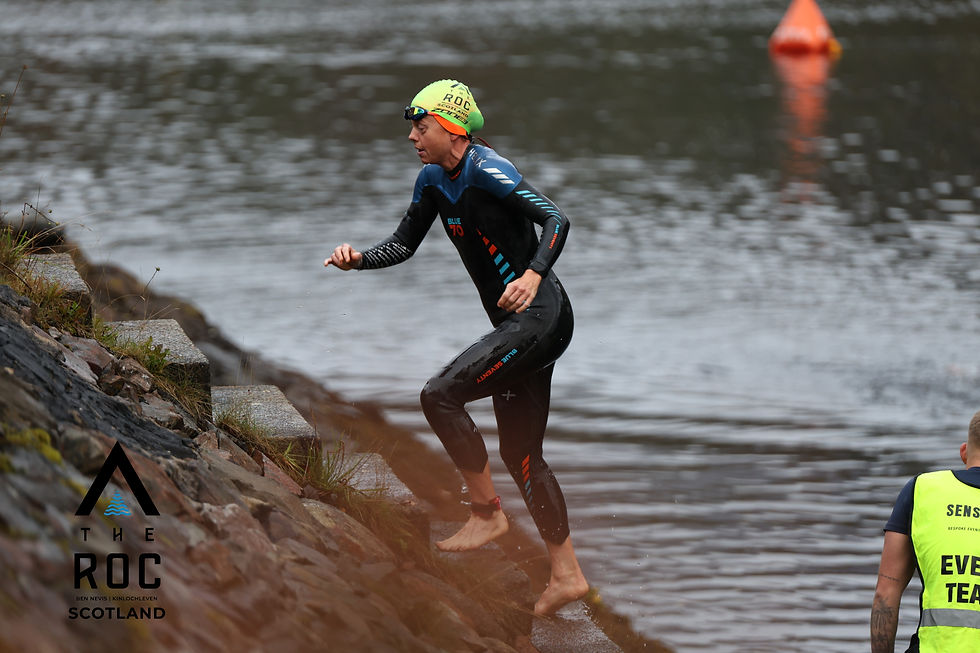
My hands went numb, like Mickey Mouse hands that couldn't feel the water. It didn't feel like swimming. It felt like survival. I ticked off the buoys one by one until the moss-covered steps came into view.
The tannoy announced that I was first woman out of the water, with Clare Weller close behind.
Riding alone
There was a kilometre run to T1, and my feet felt like blocks of ice. In transition my hands were useless. Socks, shoes and arm warmers were a battle, and I had badly underestimated how little feeling I'd have after the swim. Luckily I'd worn my gilet under my wetsuit, because there was no chance of managing a zip.
Then I was on the bike. The first climb was a timed segment, so I pushed hard, and my legs came alive. I was producing some of my best numbers of the year, which was a lovely surprise after such a long season.

The route joined the West Highland Way and the whole race changed. The ground became rough and rocky, with puddles that looked harmless until my front wheel disappeared into them. For long stretches I was completely alone in the grey, empty landscape, and I was very glad I'd chosen the full-suspension mountain bike.
I settled into the rhythm of riding and fuelling, taking regular sips of carb and electrolyte drink and PF30 chews every 20 minutes. I was taking in around 100g of carbohydrate an hour and it was sitting well. My feet were getting colder with every puddle, but otherwise everything felt good.
More than good, actually. I was riding strongly and the numbers were some of the best I'd produced all year. I knew I was having a good day on the bike, and for the first time that morning I started to believe I could be in for a really strong race.

The mountain
Rob was waiting at T2, and after such a lonely ride it was a relief to see him. He told me I was about fifth overall with a good gap in the women's race. I'd visualised the transition so many times that my body did it on autopilot: rack the bike, hang the helmet, grab the mountain bag, shoes on, go.
For the first few minutes, Ben Nevis didn't look like a mountain at all. It was just a road.
Then I turned, and the climb began.
The start was kind, with a gentle gradient and smooth cobbles. Then the path became steep, broken steps, and running was no longer an option. I put my hands on my quads and hiked. My back screamed.
This isn't running, I thought. I'm a triathlete, not a hiker.
Then I thought about the gym sessions, the hill reps and the long days on my feet. I was strong enough. I just had to keep moving.
Eventually the gradient eased and I could run again, or at least shuffle. The halfway lake appeared far below, much sooner than I expected. Hikers cheered me on, and some told me I was right up there with the men. I smiled and thanked them between breaths, but I knew better than to get carried away.

Higher up, the cloud came in and the mountain went quiet. The hikers thinned out, the rocks turned cold and slippery, and I followed the cairns through the mist. Then the leading men started flying past on their way down. The summit couldn't be far away.
Summit: 1 hour 31 minutes.
I didn't know it then, but I was fourth overall and about 20 minutes clear in the women's race.
There was no view, only grey. For a few moments it was just me and the mountain.
Then I turned around.
Coming apart
At first, a slip or a rolled ankle didn't worry me. The terrain was technical and these things happen.
But the ground got easier and I got worse.
Every time I planted a foot, my ankle collapsed outwards. I could catch it, but each time it felt like my ligaments were plasticine being pulled a little thinner. I was stumbling and catching my toes on rocks.
Slow down. You have a big lead.
I slowed down.
It made no difference.
Then Zach floated past, skipping over the rocks as though they weren't there, and I realised just how badly I was struggling.
Another ankle went.
I fell.
I got up.
I fell again.
I stopped, took a gel and drank some water. I told myself to relax and find the flow. Nothing worked. The dizziness grew until I felt spaced out, as if my legs weren't attached to me.
From a distance I must have looked drunk.

I know my body, and this wasn't fatigue. I had eaten, I had drunk and I wasn't cold.
Something was wrong.
There is only one way off a mountain, so I kept going down.
On another technical section I caught my toe and went backwards, landing hard on my coccyx. For a few seconds I just lay there, trying to work out what had happened.
Then I tried to sit up.
The dizziness hit immediately.
The whole mountain seemed to move around me and I couldn't keep myself upright. I lay back down and closed my eyes, listening to people asking if I was okay. Someone put a rucksack under my head while another hiker called for the safety team.
That was the moment I knew this was no longer something I could simply grit my teeth through. I could have a huge lead, but it meant nothing if I couldn't stay on my feet.
The long walk down
A medic and another competitor guided me down. Even then, part of me was still trying to solve the problem.
If I make it to the bottom, can I still ride?
But we kept stopping while I waited for the dizziness to settle. If I couldn't walk off the mountain safely, I had no business getting back on a bike.
Runners coming the other way kept stopping to check on me, offering food and asking what had happened, even though they were racing too. I was incredibly grateful. I also wanted the mountain to swallow me. I had started the descent as the expected winner, and now I was being walked down in my trimoore kit, feeling as if I was supposed to know exactly what I was doing.

At the bottom, two paramedics checked me over. Oxygen saturation 100%. Heart rate 54. Blood pressure, temperature and blood sugar all normal. There was no obvious explanation, but there was a very obvious decision.
The race was over.
I called Rob from the car. He had been telling everyone how well I was going, and that made it hurt even more. When I finally saw him, I grabbed him and cried. Not because I was giving up, but because I had wanted this so badly.
Stopping isn't giving up
In sport we are proud of being tough. We admire the athlete who keeps pushing when everything hurts, and I love that about it.
But on that mountain I tried everything. I slowed down. I stopped. I fuelled. I drank. I walked. I kept looking for a way back. My body simply wasn't giving me one.
A part of me still wonders if I should have argued with the medics or walked down more slowly. When I think about it properly, I know I didn't quit. My body made the decision for me.
Ben Nevis taught me that mountain running commands a huge amount of respect. You can prepare as much as you like, but until you're out there in it, you never truly know what it's like or how your body will respond.
Now I know.
I was beaten by the mountain that day, but I wasn't beaten into giving up. Giving up means walking away.
Stopping, learning and coming back stronger is something else entirely.
Harriet Haywood won the women's race, and she was a worthy winner. Her mountain skills and determination were rewarded on a day when anything could happen.
My trimoore team mates, Zach & Lauren finished fifth overall and second in the Trilogy series.
I was proud of them all.

If you're thinking of racing The ROC...
Train for the cold. Sea swims without a wetsuit prepared me for the shock. Expect numb hands and feet.
Make transitions easy for frozen fingers. Layer up under your wetsuit and avoid zips and anything fiddly.
Pack dry socks in T2. (You'll thank me.)
Ride a bike you trust. Gravel bikes are allowed, but a full-suspension bike gave me confidence on the rough West Highland Way.
Train to hike, not just run. Ben Nevis has long sections of steep steps. Strength work for your back and legs pays off.
Respect the descent. It's technical, the visibility can disappear, and it is harder than the climb.
Fuel like it's a long day, because it is. Make a plan and stick to it from the first pedal stroke.
The ROC Scotland is one of the hardest, wildest and most beautiful races I've ever started. If you've ever wondered what you're capable of, this is the race that will show you.

Thank you
A huge thank you to the medical and safety team at The ROC. They looked after me on the mountain, got me down safely and checked me over with care and patience. Thank you also to every competitor and hiker who stopped to make sure I was okay. You made a very hard day easier to bear.
This time, the mountain won.
But I'm taking everything it taught me into the winter, and I have big goals for 2027.


Comments